This is an exciting and challenging time for the healthcare industry. Technology is advancing almost faster than humans can keep pace. New legislation is creating fresh challenges for the future of healthcare, and the shifting population demographic continues to place more pressure on healthcare facilities.
Amidst these changes, healthcare facilities are facing a critical staffing crisis, making healthcare workforce optimization more essential than ever. Facilities must strike a delicate balance between providing high-quality care and effective budget management.
How can the healthcare industry thrive in these challenging times?
Healthcare managers can no longer continue to rely solely on traditional staffing methods. Overusing existing staff can lead to heavy overtime costs and even staff burnout. Traditional agencies often charge high fees, and their methods can be slower and more time-consuming.
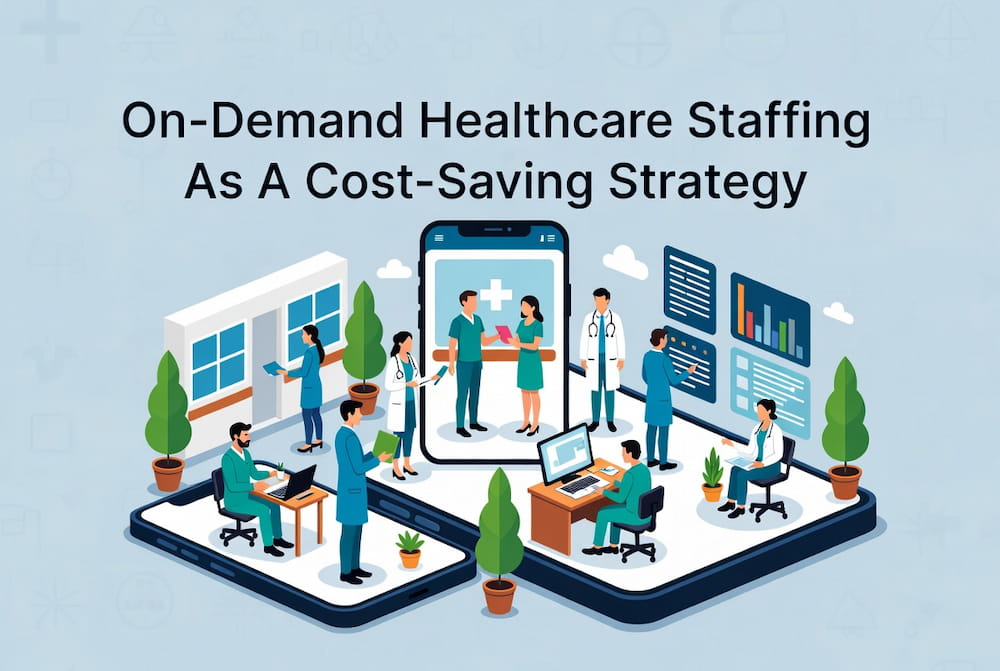
Facilities need cost-effective, flexible alternatives that enable them to quickly fill shifts with excellent clinicians. On-demand staffing allows managers to provide cost-effective but highly skilled coverage. It is a strategic financial move for facilities facing pressures on multiple fronts.
The rising cost of full-time clinical labor
Full-time clinical labor now accounts for a significant—and rapidly rising—portion of healthcare staffing costs, fueled by surging demand for skilled professionals to serve an aging population.
Understanding the overhead
Salaries for registered nurses and specialized medical staff have surged as facilities compete to attract top talent. Other overhead costs for hiring full-time staff include:
- Benefits
- Insurance contributions
- Ongoing training expenses
Another financial pressure healthcare facilities face is complying with regulatory requirements, including multiple standards and training programs.
In order to tackle rising costs, organizations must adopt cost-effective staffing models that can adapt to both patient demand and budgetary constraints.
The hidden financial impact of turnover and burnout
One of the greatest challenges facing healthcare facilities today is turnover among healthcare staff. High turnover rates lead to significant financial setbacks, including:
- Costs related to recruiting, onboarding, and training replacements
- Impacted morale, leading to increased stress and burnout for remaining employees
- Decreased quality of patient care
- Increased liability risks due to errors stemming from understaffing
Burnout not only affects individual healthcare workers but also has a ripple effect across entire organizations. Clinicians are opting for different career paths or seeking positions in less stressful environments.
Healthcare facilities must work to retain current clinicians by promoting wellness programs and adopting flexible staffing models to reduce the economic impact of staffing shortages.
How census volatility undermines traditional staffing models
Healthcare facilities often encounter significant fluctuations in patient census due to seasonal illnesses, economic conditions, or public health crises. Traditional staffing models, which typically assume stable patient volumes, struggle to adapt quickly when patient numbers fluctuate unexpectedly.
The risks of fixed staffing:
- Overstaffing: Drains financial resources during quieter periods
- Understaffing: Compromises patient care and increases employee burnout during periods of high demand
This volatility underscores the importance of staffing elasticity in healthcare.
When on-demand staffing can save facilities money
Flexible models enable organizations to adjust quickly to changing needs, avoiding overspending while maintaining high-quality care, unlike fixed approaches.
Sudden census fluctuations
One of the primary advantages of on-demand healthcare staffing is its ability to accommodate sudden fluctuations in census. With limited financial commitment, facilities can scale their workforce according to demand.
This agility allows healthcare organizations to maintain optimal staffing levels, ensuring that patients receive timely care while preventing financial waste associated with overstaffing.
By harnessing on-demand staffing solutions, facilities can work with skilled professionals who are ready to step in when staffing needs arise unexpectedly.
This ensures that organizations can control costs and respond quickly to changes in patient volume.
Excess overtime utilization
Overtime usage is another area where many healthcare organizations find themselves overspending.
When short-staffed, facilities often resort to requiring current employees to work additional hours, which comes at a cost both financial and emotional.
Benefits of on-demand staffing vs overtime:
- Quick access to per diem nurse staffing to fill gaps
- Reduce expensive overtime costs and staff burnout
Long-term contract labor commitments
While long-term contract labor may seem like a secure staffing option, it frequently ties organizations to fixed costs that may become unsustainable. As patient trends change, the financial burden of these commitments can limit the facility’s ability to invest in other operational necessities.
Sourcing qualified clinicians on-demand provides a dynamic alternative. In this context, these platforms serve as essential alternatives to contract labor, offering commitment-free flexibility.
By relying on flexible staffing solutions, facilities can:
- Avoid restrictive long-term contracts
- Allocate resources more efficiently
- Pivot to meet financial targets and organizational goals
Where the economics of contingent staffing pay off
Contingent nurse staffing is more than a solution to reducing reliance on overtime and avoiding long-term labor commitments. It can provide access to talent, handle credentialing, improve workload distribution, and respond quickly to urgent staffing needs.
Real-time access to larger talent pools
On-demand staffing platforms open up access to larger talent pools, enabling facilities to connect with qualified professionals quickly. For example, the staffing marketplace platform Nursa touts over 400,000 verified nursing professionals on the platform, offering facilities a deep pool of qualified talent.
This capability is particularly beneficial for specialty positions, where finding skilled workers can be a challenge. With traditional recruitment methods often requiring extensive time and resources, quicker access to skilled labor can significantly benefit an organization.
Moreover, real-time access enhances competitive advantage. Facilities that can fill shifts promptly are more likely to provide consistent and high-quality patient care, thereby building a strong reputation in the community.
Automated credentialing and time-to-fill reductions
The process of credentialing healthcare staff can be slow and cumbersome, often lengthening time-to-fill for critical positions. However, with the advent of technology in staffing solutions, this process has become significantly more efficient.
Automated credentialing systems streamline the vetting process for on-demand staff:
- Verifies licensure and qualifications quickly
- Reduces time-to-fill for critical positions
- Contributes to enhanced operational efficiency
As a result, organizations can maintain better staffing ratios, ensuring they meet the required standards for patient care. Swift onboarding processes not only alleviate immediate staffing needs but also contribute to staffing efficiency in healthcare.
Better workload distribution reduces injuries and burnout
An essential benefit of adopting flexible healthcare staffing is improved workload distribution. By aligning staffing levels with actual patient needs, organizations can mitigate the risks associated with employee overload.
Mitigating workplace risks:
- Workplace injuries caused by high workloads
- Staff burnout among dedicated employees
When schedule gaps can be covered with on-demand staffing, healthcare facilities can ensure that current clinicians are neither overworked nor underutilized.
Rapid response to call outs
Staff call outs can lead to operational chaos in healthcare facilities. The ability to rapidly respond to these situations is critical.
On-demand healthcare staffing enables organizations to quickly bring in substitute nurses or medical staff at a moment’s notice, ensuring that patient care isn’t disrupted.
By acting swiftly, facilities not only maintain quality of care but also alleviate stress on remaining staff, further reducing the risks of burnout and turnover.
The bottom line: Build flexibility into your staffing mix
The healthcare industry is navigating complex times that necessitate dynamic and flexible staffing solutions. On-demand healthcare staffing can significantly improve both operational efficiency and financial stability.
The current economic climate—characterized by rising labor costs, an aging population, and unpredictable patient census levels—requires an agile staffing strategy. Facilities that incorporate flexible staffing solutions can navigate these challenges more adeptly, ensuring they not only meet regulatory standards and patient needs but also do so in a financially sound manner.
Facilities can optimize their resource allocation, minimize wasted expenditures, and enhance their capacity to respond to patient care demands. By reducing their reliance on traditional staffing models, organizations can build a resilient and adaptable workforce that is better prepared for the future.
For healthcare providers looking to embrace this evolution, staffing platforms represent invaluable resources for achieving a dynamic staffing strategy. As the healthcare landscape continues to shift, leveraging on-demand staffing will not only safeguard operational efficiency but will also drive improved patient outcomes and organizational success.
Expand your knowledge and check out more posts on our blog!
Read Also
- Full-Arch Dental Tourism: Why UK Patients With Severe Bone Loss Are Looking Abroad
 Dental implants have become one of the fastest-growing segments of private dentistry. Within that market, one patient group behaves very differently from the rest: people who have been told they do not have enough upper jawbone for conventional implants. For these patients, the choice is rarely between one clinic and another. It is between a… Read more: Full-Arch Dental Tourism: Why UK Patients With Severe Bone Loss Are Looking Abroad
 - Levels of Mental Health Care and When to Seek SupportMental health care can range from occasional outpatient appointments to 24-hour hospital treatment. The appropriate level depends on safety, symptom severity, daily functioning, medical needs, available support, treatment history and personal preferences. A licensed clinician should assess these factors rather than relying on a symptom list alone. Need help now? In the United States, call… Read more: Levels of Mental Health Care and When to Seek Support
- How to Choose a Shilajit Brand Based on the ResearchIn a randomized trial published in the Journal of the International Society of Sports Nutrition in 2019, 63 active men took 250 mg of standardized shilajit, 500 mg, or a placebo every day for eight weeks, and the benefit for strength retention after a fatiguing workout appeared only at 500 mg. For anyone choosing a… Read more: How to Choose a Shilajit Brand Based on the Research
- Can Outsourced Telepsychiatry Help Healthcare Organizations Keep Pace With Modern Mental Health Screening?Mental healthcare is changing quickly, but many hospitals, clinics, schools, correctional facilities, and community health organizations do not have enough psychiatric professionals available to turn new screening approaches into timely clinical care. Outsourced telepsychiatry offers one way to close that gap. FasPsych, for example, connects healthcare organizations with psychiatrists, psychiatric nurse practitioners, and other behavioral… Read more: Can Outsourced Telepsychiatry Help Healthcare Organizations Keep Pace With Modern Mental Health Screening?
- How to Incorporate Relaxation into Your Busy ScheduleFinding balance when you have a packed daily agenda often feels out of reach. Between work duties, family obligations, and personal projects, personal rest usually gets pushed to the bottom of the list. Small, intentional shifts in daily habits can help restore calm without requiring hours of extra free time. Continue reading to discover everything… Read more: How to Incorporate Relaxation into Your Busy Schedule
- Red Light Therapy for Skin and Wellness: Meet Vital Red Light TherapyModern wellness is not always about complicated treatments or long routines. Many people are now looking for simple, convenient ways to support their skin, recovery, and overall wellness at home. One technology getting more attention is red light therapy. Red light therapy uses specific wavelengths of red and near-infrared light to support the body’s natural… Read more: Red Light Therapy for Skin and Wellness: Meet Vital Red Light Therapy
- Managing Shock Loss After a Hair Transplant: The Financial and Clinical Imperative of Post-Op CareIn the rapidly evolving landscape of private healthcare, executive leadership within cosmetic and restorative surgery clinics faces a dual challenge: maintaining strict clinical standards while maximizing patient lifetime value (LTV) and brand advocacy. As the global medical tourism and elective procedure markets expand, clinical outcome quality alone is no longer the sole differentiator for premium… Read more: Managing Shock Loss After a Hair Transplant: The Financial and Clinical Imperative of Post-Op Care
- Transform Your Skin Health: Premier Gluta IV Therapy in DubaiThis comprehensive guide explores how modern intravenous wellness treatments can help revitalize your complexion, boost immune function, and support overall cellular health. By incorporating modern IV therapy Dubai services into a routine health regimen, individuals can achieve direct nutrient absorption for optimal results. Selecting a customized gluta IV drip Dubai treatment provides targeted antioxidant defense,… Read more: Transform Your Skin Health: Premier Gluta IV Therapy in Dubai